 Tilibou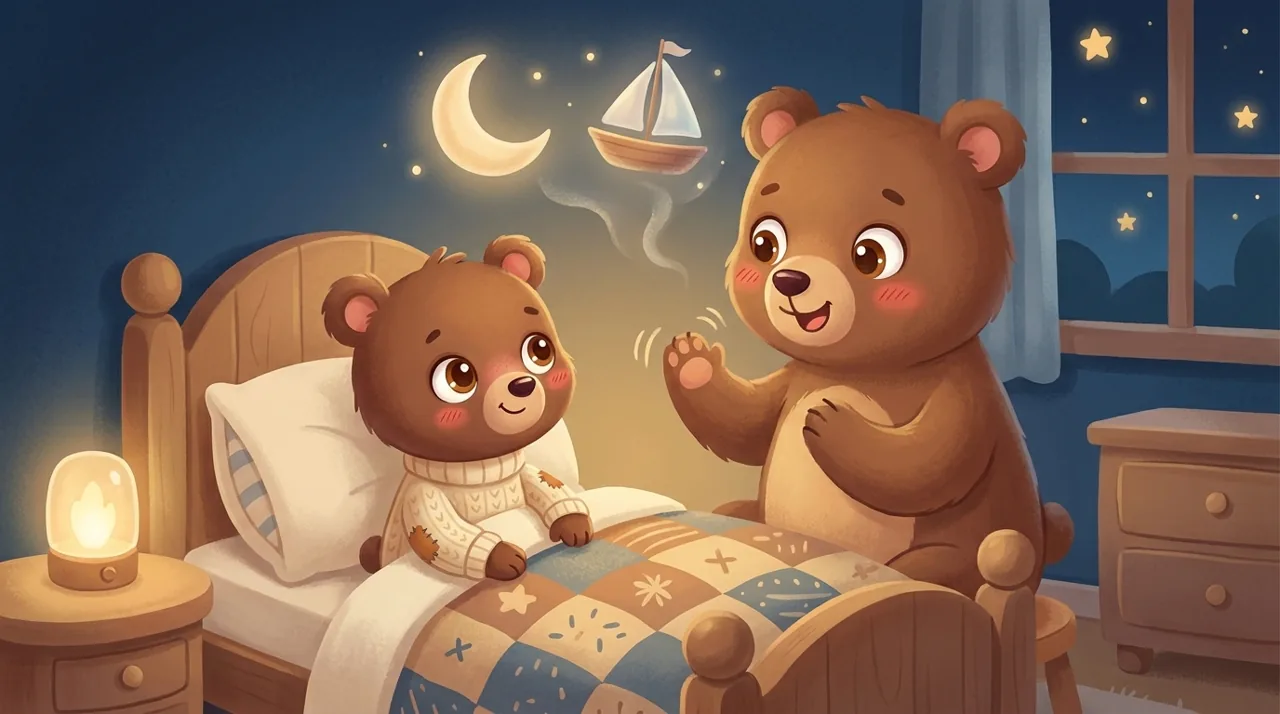
Telling a story without a book (off the top of your head)
Lights off, no book within reach, and a child asking for “a story.” Do not panic: telling one off the top of your head is simpler than you think, and it often makes the loveliest moments. You do not need to be a born storyteller. With two or three ready-made frames and a recurring character, you can improvise on any evening. Here is the method.
Why telling stories off the top of your head is worth it
A story told without a book has something the book does not: your eyes. You look at your child, you adapt as they react, you lower your voice when it is needed. And the magic works even if the story is very simple. mpedia.fr, written by AFPA paediatricians (the French Association of Ambulatory Paediatrics), reminds us: “tell a story (even if the content is not grasped, the musicality of language does its job).” In other words, your voice is enough. The plot can be tiny.
The other benefit is bedtime itself. Telling stories off the top of your head happens in the dark, with no screen and no lamp. Health authorities recommend at least an hour without screens before bedtime: a story told ticks that box effortlessly, lights off, in the calm. The World Health Organization also values “storytelling” as a quality activity for the child. You need nothing, except yourself.
Three frames easy to reuse endlessly
The secret of parents who “make up” a story every evening: they invent nothing. They have a few ready-made moulds that they fill differently each time. Here are the simplest:
- The little quest. A character has lost something (their comfort toy, a star, the way home). They set off to find it, meet two or three helpers along the way, and finally find it. That is all.
- An animal's day. You follow a rabbit, a cat, a little bear from morning to night: they wake up, they play, they eat, they have a little adventure, then they fall asleep. Reassuring and easy to stretch or shorten.
- The peaceful journey. The character wanders through a soft place (a sleepy forest, the bottom of the sea, the clouds) and meets calm things. No twists: just a stroll to drift toward sleep.
Keep the gentlest frames for the evening. Naître et grandir, a Quebec parenting reference site, reminds us that “the hour before bedtime should unfold calmly”: a big adventure full of twists wakes a child up more than it settles them. The peaceful journey, on the other hand, works wonders at bedtime.
“The Map the Pelican Ate”
The very first episode of Tom the Pirate, aboard the Royal Sardine, the smallest pirate ship in the world. Adventure for the ears, no screen needed. You handle the cuddle, Tilibou handles the voice.
Listen to the storyThe recurring character: your best ally
If you only remember one tip, let it be this: invent a hero who comes back every evening. A little animal, a funny creature, an imaginary child who looks a bit like yours. Once the character is set up, you no longer have to recreate everything. They live a new little adventure, and off you go.
This return of the same hero works like the rest of the ritual: it reassures through familiarity. mpedia.fr says of bedtime gestures: “by repeating the same gestures every evening, you create a soothing and trusting atmosphere.” A recurring character works the same way. The child asks for them, anticipates them, grows attached. Bonus: they can even take part, suggesting what the hero does tonight. You are no longer alone at the controls.
And do not be afraid to repeat a story that went down well. Hearing the same adventure again does not bore a child, quite the opposite: they love knowing what is going to happen. You can bring out the same one the following week, almost word for word.
Making it up together, with your child
Telling a story off the top of your head is also a chance to make your child a co-author. Let them choose the hero (a hedgehog, a child who looks like them, a dragon), the setting, what the character slips into their pocket before setting off. The simplest way: ask a question at each step rather than deciding everything. “And now, who do they meet in the forest?” “What colour is their house, do you think?” They answer, you bounce off it, and the story becomes a little bit theirs.
Welcome all their ideas, even the most unexpected. A dragon appears? It becomes a kind dragon that blows bubbles. Nothing is wrong in a made-up story. Two or three questions are enough, otherwise the game turns into a test. The idea is a calm game of ping-pong: you tell a bit, they suggest what comes next, you pick it up again, and the pace slows as the eyelids grow heavy.
Follow their mood of the evening too. The youngest mostly add a word, an animal, a sound effect; older ones suggest whole twists. Some evenings, they will prefer simply to listen, and that is perfectly fine. Along the way, a child who makes things up often slips in what is on their mind: a friend, a fear, a dream. No need to analyse, just to welcome it.
Improvising without stress: a few crutches
That leaves the fear of the blank page, the evening when your mind is empty. A few crutches help you get started without anxiety. First, draw on the real day: did your child see a dog at the park? The hero meets a dog. Did they eat pasta? So does the hero. Recycling reality is the easiest fuel.
Next, allow yourself the very short format. A two-minute story is a real story. No one is asking you for a novel. If inspiration stalls, send the character to sleep: “and the little rabbit, tired from a lovely day, closed his eyes, just like you now.” A ready-made ending that drifts toward sleep.
Finally, ask yourself plainly: the goal is not a beautiful story, it is a calm moment with your child. A relaxed parent tells a better story than a parent under pressure. And on the evenings with no idea at all, audio takes over, guilt-free. You will take the reins again tomorrow.
The questions you are asking
I have no imagination, how do I tell a story without a book?
You do not need a wild imagination. Use a ready-made frame (a little quest, an animal's day, a peaceful stroll) and fill it with details from the child's real day. A character who comes back every evening saves you from reinventing everything.
My story is too short, is that a problem?
Not at all. A two-minute story is a real story. What matters at bedtime is the calm moment and the landmark that comes back, not the length. In the evening, a short, gentle frame beats a big adventure that wakes the child up.
Is it better to tell a story off the top of your head or to listen to an audio story?
Both have their place and do not compete. Telling a story off the top of your head creates a moment of presence in the dark; audio takes over on the evenings with no inspiration or no energy. The essential thing remains a calm and regular ritual at bedtime.
What if my child makes up a scary story?
It happens, and there is no need to cut it short. Welcome the idea, then gently steer the story back toward calm: the scary dragon can become a kind dragon that blows bubbles, and the hero always ends up going home and falling asleep. If a fear keeps coming back and worries your child day to day, talk to your doctor or paediatrician.