 Tilibou
The benefits of coloring for children
You hand over a picture and a few pencils, and there they are, quiet for ten minutes. Coloring has long carried the reputation of being something “to keep children busy.” Look more closely at the little hand pressing down, the tongue poking out in concentration, and you'll see something else entirely: a child building up their hand, settling their attention, and calming down. Here is what coloring really develops, at what age, and why it makes such a lovely moment in the evening.
First, a real workout for the hand
This is the most concrete benefit, the one you can see with the naked eye. To color, a child learns to hold a pencil, guide it, and control the movement. Naître et grandir, a Quebec reference on child development, sums it up clearly: when drawing or coloring, a child “practices holding and guiding a pencil as well as controlling their movement,” and “little by little, their line gains precision.”
That precision, which comes on gently, has a behind-the-scenes name: fine motor skills. These are all the tiny muscles in the fingers and hand that carry out delicate movements. And coloring genuinely trains them, with a benefit that reaches beyond the page: it prepares the child to write. Coloring also improves hand-eye coordination, the ability to use what you see to guide the movement of the hand across the paper. So many building blocks that will help the day it is time to form letters.
A little tip on materials: wax crayons, often smaller, take a bit more force to lay down color. So they work the hand even more than markers do. Nothing special to buy, a box of crayons is enough.
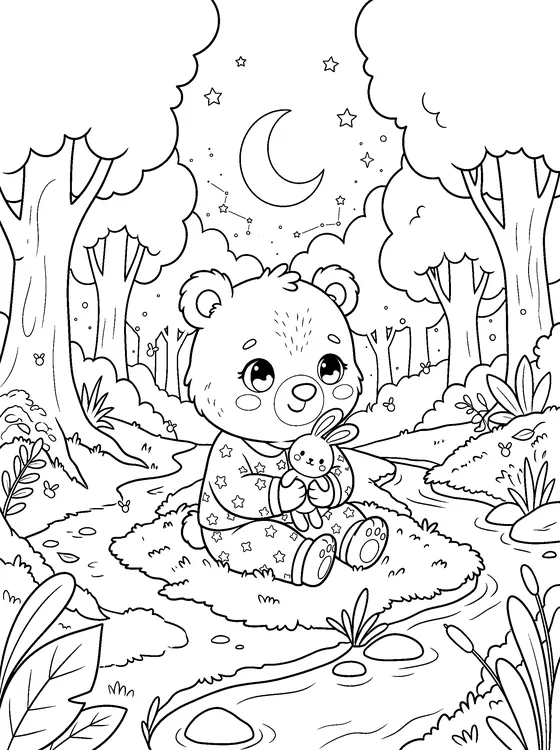 Noisette, to color Print →
Staying inside the lines means learning to concentrate
Here is a quieter benefit, and yet a precious one. When a child works hard not to go over the edges, they place their attention on a task and hold it over time. Here too, Naître et grandir is explicit: coloring asks the child “to pay attention to what they are doing,” for example “to stay inside the lines of a picture to color.”
This voluntary attention, the kind you choose to keep on one thing, can be trained like a muscle. Coloring exercises it gently, without the child feeling like they are making an effort. There is also, along the way, a first lesson in boundaries: by trying not to go over the lines, the child gets used to respecting a rule. And a real bit of reasoning kicks in. Which color, in which direction, pressing harder or softer to make it darker or lighter. Coloring a simple apple is already a string of mini-decisions.
A moment that truly soothes
Ask a parent why they bring out the pencils on a day of inner turmoil, and they will often tell you the same thing: “it calms them down.” It is not just a feeling. Coloring has a recognized soothing effect, so much so that among adults it has become a form of art therapy. Naître et grandir notes as much for grown-ups: coloring patterns “is thought to have a soothing effect that helps you let go of small everyday worries and feel fewer difficult emotions.”
Research points the same way, in adults. In a trial carried out in Taiwan with 120 people aged 55 to 75, those who had colored a mandala for twenty minutes then felt calmer and more relaxed than those who had read; coloring a simple grid, on the other hand, did not have that effect. It is a single study, in adults, but it matches what many parents observe: a calm task, with a beginning and an end, keeps the mind just busy enough to stop it from racing. The child anchors themselves in a gentle movement, and everything else settles.
That is exactly why coloring belongs in the evening. The hour before bed is better kept calm, and a quiet activity helps the child slow down before the night, far better than a cartoon that winds them up.
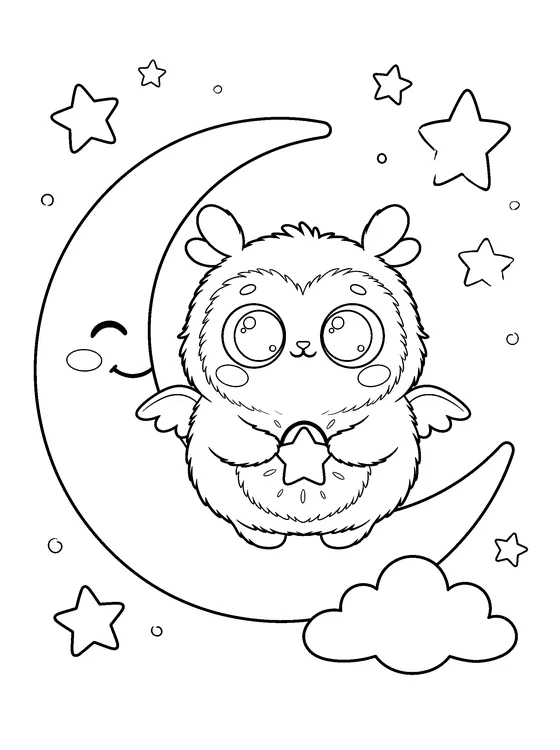 Tilibou the owl, to color Print →
Coloring to say what cannot yet be said
A three-year-old does not always have the words for their big emotions. The pencil does. Through their marks and colors, the child puts a piece of their inner world out into the open. Naître et grandir points out that this activity “also helps them express and manage emotions like fear.”
Be careful not to over-interpret, though. Lots of black or red does not mean anger or sadness: that day, they may simply have been the pencils on top of the box. The best thing is to listen to what the child says about their drawing, without pinning a meaning on it. “Tell me about it,” rather than “why all that black.”
And finally, there is the pride of finishing. Choosing the colors, filling in, finishing, showing it off. The child exercises real control over their little project, and draws genuine confidence from it. The parent's role comes down to very little: comment rather than grade. “I like the colors you chose” beats “that's pretty,” because it acknowledges what they did.
 Léo & Pistache, to color Print →
The joy of paper, away from screens
In the age of the tablet, coloring has an advantage we tend to forget: it fits in a sheet of paper and a box of pencils, with no blue light and no notifications. And for the little hand, the difference is real. Naître et grandir puts it plainly: it is better to color “with real materials rather than on an electronic tablet,” because it develops fine motor skills and limits screen time. A finger sliding across glass builds nothing.
This ties in with a broader recommendation. To grow up healthy, the World Health Organization encourages young children to sit less in front of a screen and play more, favoring calm, creative activities over tablet time. Coloring ticks the box effortlessly. It is also why it pairs so well with an audio story: the child colors while a voice tells the tale, and the moment stays gentle, with no screen switched on.
Which coloring page for which age?
The same drawing does not suit a two-year-old and a seven-year-old. Here are some guidelines, keeping in mind that every child moves at their own pace.
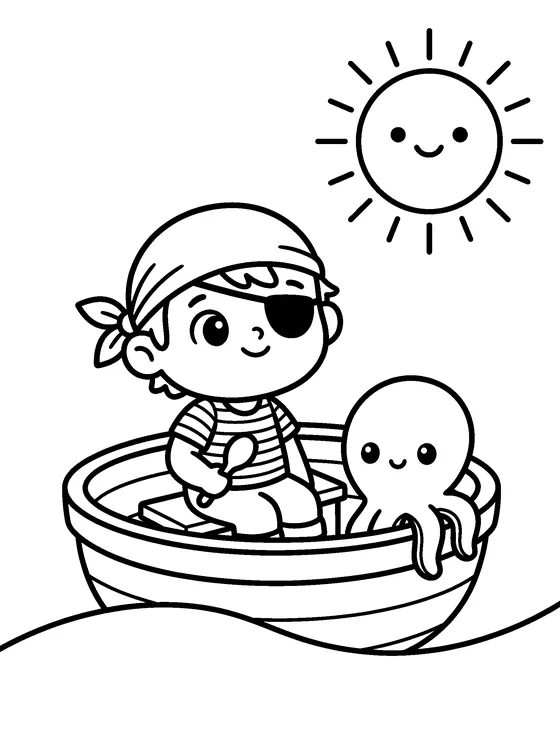
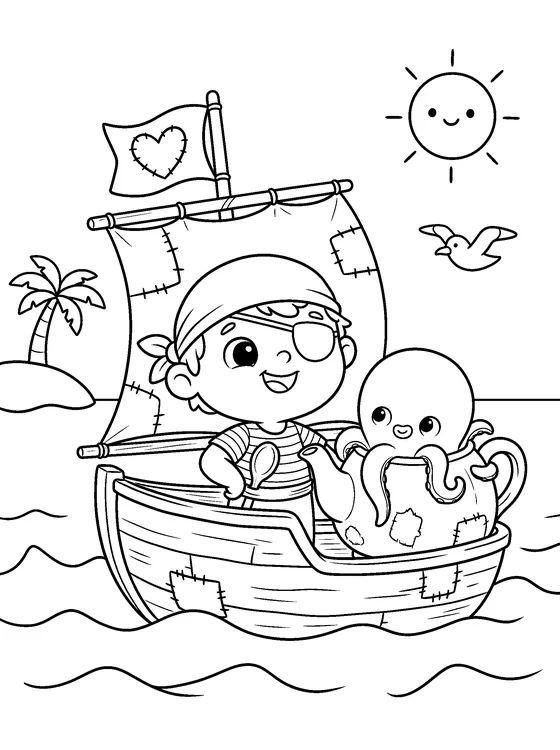
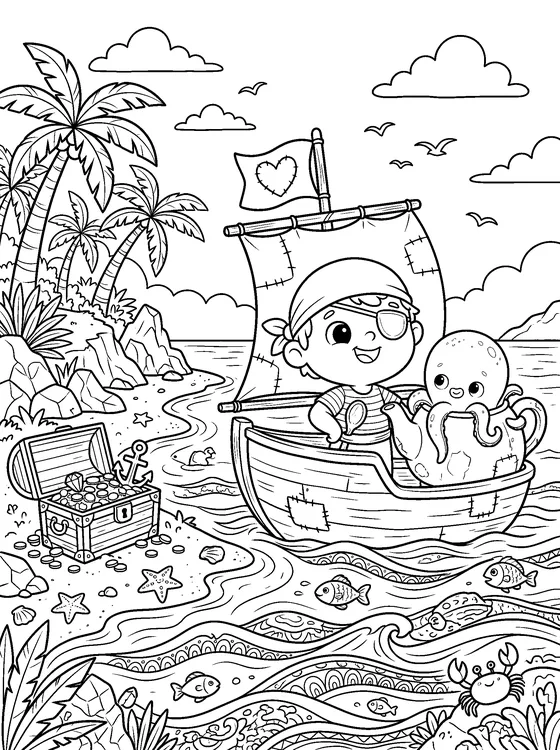
The same hero, in three levels: the areas grow finer with age. (Here, Tom the Pirate.)
2 to 3 years: the joy of the movement, not the result
At this age, the child scribbles and discovers the delight of watching colors appear. They are not trying to stay inside the lines yet, and that is perfectly normal. Offer large areas, very simple drawings, chunky pencils that are easy to hold. Above all, do not ask them to “do it well”: at this age, they are playing, not producing. Let them go over the edges, scribble on top, start again.
4 to 5 years: the first lines respected
This is the pivotal age. The child begins to color “the inside of a simple shape, respecting the outline of the drawing more and more,” as Naître et grandir describes it. More defined areas, recognizable shapes, favorite heroes: all of this helps them apply themselves without getting discouraged. It is also the period when, in parallel, they practice tracing their first letters.
6 to 8 years: details and pride
The hand is steadier, attention holds longer. The child enjoys finer areas, richer patterns, scenes to tell a story about. They love finishing a neat drawing and showing it off. It is the perfect age for more detailed coloring pages that offer a real little challenge.
That is exactly the idea behind our free printable Tilibou coloring pages: each hero comes in three levels, for ages 2-3, 4-5 and 6-8. You choose based on your child, you print, and you bring out the markers.
So, coloring or free drawing?
The real answer is both. Drawing on a blank sheet and coloring share benefits, fine motor skills, attention, reasoning, and they complement each other for the rest. Coloring teaches you to follow a framework and to calm down. Free drawing, on the other hand, leaves all the room for imagination. Naître et grandir puts it nicely: the biggest advantage of drawing over coloring is that it “lets your child fully express their creativity.”
No need to pick a side. There is a lovely in-between, the anti-coloring page: a drawing to complete according to a prompt, where the child colors and invents at the same time. The principle to remember comes down to one word: vary. One day the pencils inside the lines, one day the big blank sheet, and your child gains on both sides.
“The Big Box of Colours”
At Lila's school, a big table, brand-new paper and pots of colour: it is painting time. A story that makes you want to get the crayons out. You handle the cuddle, Tilibou handles the voice.
Listen to the story
The questions you are asking yourself
At what age does coloring become useful?
Very early. From the age of one, the child scribbles and is already working their hand and their joy in the movement. Before the age of three, do not look for lines being respected: offer large areas and chunky pencils, and let them explore freely.
At what age does a child stay inside the lines?
Often around 4 to 5 years, the child colors the inside of a simple shape, respecting the outline better and better, according to Naître et grandir. Before that, going over the edges is part of learning. Every child moves at their own pace, and there is no need to worry about it.
Does coloring make a child less creative than free drawing?
Free drawing does leave more room for imagination, it is true. But coloring brings other benefits, like attention and respecting a framework. The ideal is to offer both, and to dip into the anti-coloring page too, which blends coloring and inventing.
Is coloring in the evening a good idea?
Yes, because it is a calm, screen-free activity that helps the child slow down before the night. Paired with a gentle story, it eases the transition toward sleep nicely.