 Tilibou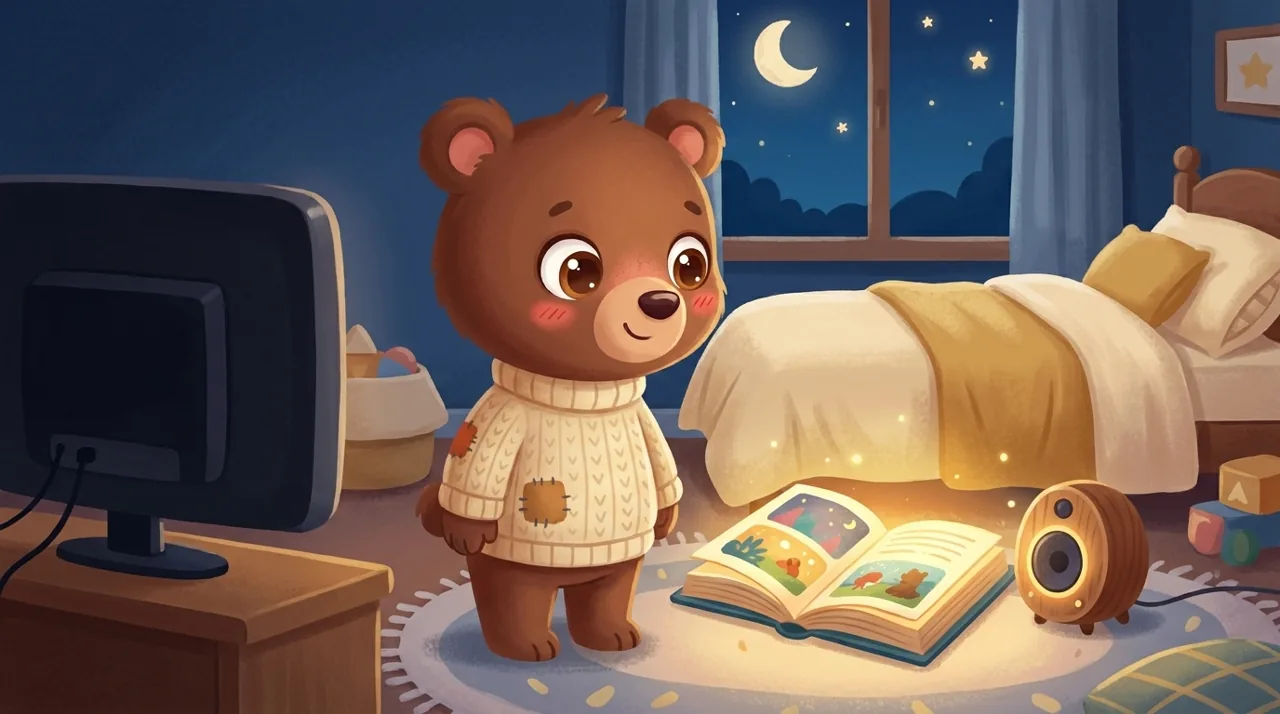
Replacing the evening cartoon with a story
The evening cartoon has become the handy reflex in plenty of families. The trouble is, when it is time to switch it off, that is often where the meltdown starts. If you are looking for an alternative to screens at night for your child, a story to listen to is a gentle option: it keeps that "time of my own" feeling, without the glow of a screen or the fight to turn it off. Here is how to make the switch gently, without a battle of wills.
Why screens and bedtime are a bad mix
The problem is not the cartoon itself, it is where it sits, right before sleep. Health authorities recommend giving children screen-free time before bed: public-health guidance advises turning off the television about an hour before going to bed, and to keep at least an hour without screens before bedtime.
Then there is that famous moment when you have to switch it off. Cutting a cartoon in the middle means asking a tired child to give up something captivating. Hence the tears, the "just one more," and the tension rising exactly when you want things to wind down. Yet the hour before bedtime should unfold calmly. A story you listen to, on the other hand, ends on its own: no button to wrestle out of small hands.
What an audio story keeps from the cartoon
What parents fear is taking something away from their child. In reality, an audio story keeps the heart of what your child loves about a cartoon: characters, an adventure, a world to escape into. What it removes is mostly the screen and the visual buzz that comes with it.
It even adds something. A story that is told feeds the imagination: the child builds the images in their own head, at their own pace. Paediatricians note that a storytelling voice works even when the content is not fully grasped, because the musicality of language does its job. So you keep the pleasure of the story, you gain calm, and you give imagination a place to play.
Tilibou stories
Screen-free bedtime stories, short and gentle, perfect for taking over from the cartoon at bedtime. You dim the lights, Tilibou tells the story.
Listen to an episodeThe transition, step by step
A sudden switch often ends in a standoff. Better to go gradually, keeping the ritual positive rather than laying down a ban. Here is an approach that spares everyone:
- Pick the right evening to start, not a night of heavy tiredness or the return from a hectic weekend.
- Present the story as a gift, not a punishment: "tonight, we have a new story just for you."
- At first, alternate. The cartoon is still allowed earlier in the evening; the story takes the last spot, right before sleep.
- Set up a scene that helps: soft light, a comfort toy, a cuddling position. The atmosphere does half the work.
- Let your child choose the story when you can. Choosing is already buying in.
Give yourself a few days. Evening after evening, the story becomes the new landmark, and the urge for a bedtime cartoon fades on its own. The key is to replace one pleasure with another pleasure, not to create a void.
Holding steady the first few nights
The first few nights, expect a bit of resistance: it is normal, your child is testing whether the change is real. Stay warm and consistent. A ritual that comes back the same way, at the same time, is reassuring: regular bedtimes, even on weekends, are worth keeping. Consistency does more for the transition than any speech.
Keep the moment short and clearly bounded too. A good bedtime routine is "fairly short (15 to 20 minutes) and the same from one day to the next." One story, sometimes two, then the cuddle and lights out: that clear frame stops the transition from turning into a new round of negotiation.
Finally, be gentle, with your child and with yourself. Some evenings the screen will take over again, and that is not a failure. The goal is not perfection but a trend: more and more evenings with a story, fewer and fewer with a bedtime cartoon. Step by step, this new ritual becomes the reflex, and the evening finds its calm again.
The questions you are asking
Why avoid a cartoon right before sleep?
Mostly because of the timing. Health authorities recommend screen-free time before bed: guidance advises turning off the television about an hour before sleep, and keeping at least an hour without screens before going to bed. Cutting a cartoon mid-action also often creates tension, exactly when you are looking for calm.
My child asks for the cartoon, how do I make the transition?
Gently, without a battle of wills. Present the story as a gift, alternate at first, and give the story the very last spot before sleep. Consistency helps a lot: regular bedtimes are worth keeping. Evening after evening, the new ritual settles in and the pull of the screen fades.
Does an audio story really hold attention as well as a screen?
It holds it differently, and that is all the better for the evening. The story keeps characters and an adventure, while letting the child build their own images. A storytelling voice works even beyond the words understood. You keep the pleasure of the story, without the glow of a screen.