 Tilibou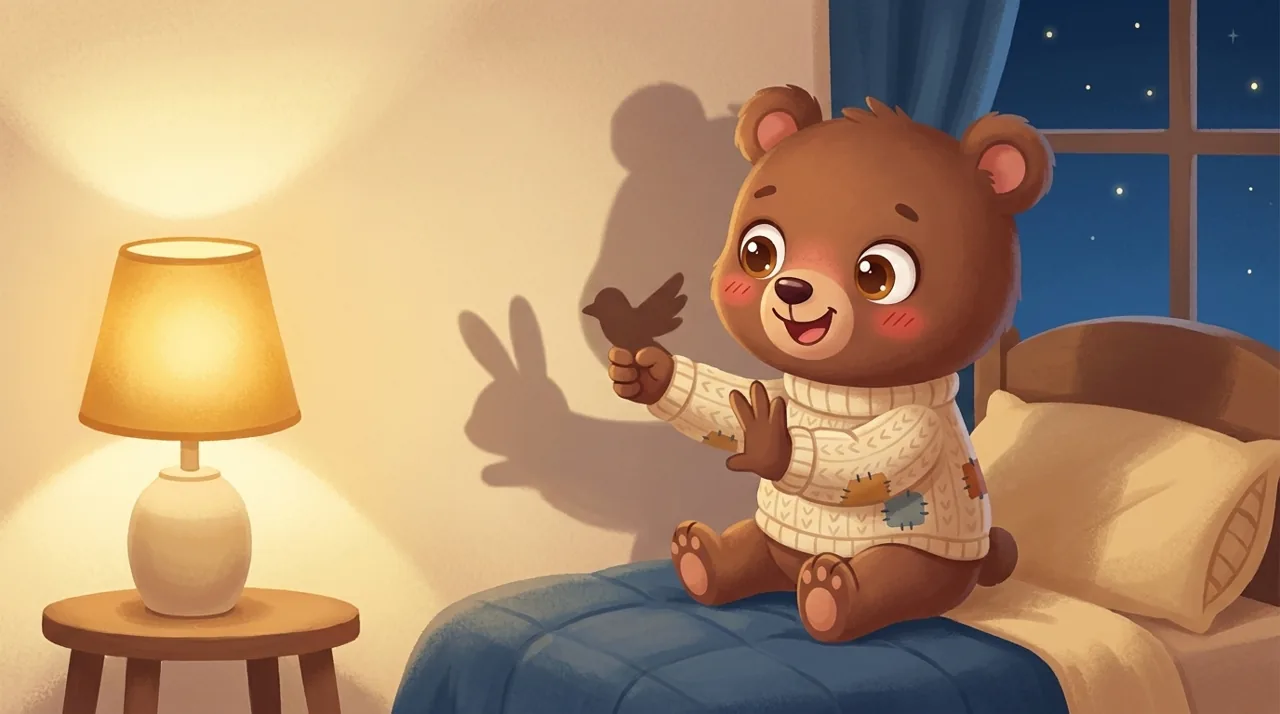
Hand shadow games in the evening
All it takes is a bare wall, a small lamp and two hands. You turn off the ceiling light, switch on a warm glow, and suddenly a rabbit wiggles its ears on the wall. Shadow games are one of those little moments that cost nothing and gently lay the end of the day to rest. Here's how to set them up, and why they work so well just before bed.
Why shadows soothe just before sleep
What makes shadow games precious in the evening is that they turn the volume of everything down. The harsh ceiling light gives way to a soft glow. The voice goes lower, almost a whisper. Movements slow down, because a shadow doesn't like haste: if you move too fast, the rabbit blurs. Everything pushes toward calm, naturally.
And that's exactly the mood recommended at the end of the day. The hour before bedtime should unfold quietly. A shadow game fits into that hour without disturbing it: it's a settled activity, screen-free, without excitement, that brings your child down while keeping a smile at the corner of their lips.
There's also the magic. At this age, a simple silhouette of a dog opening its mouth on the wall becomes a little show. Your child is captivated, but with a quiet wonder, not an overexcited one. It's this quality of gentle attention that makes the shadow game an ideal bedtime companion.
Setting up the shadow corner in two minutes
No need for special equipment or any particular talent. You mostly need a single source of light and a clear wall. Here's how to set the scene:
- Choose a light, clear wall, facing the bed or beside it.
- Turn off the ceiling light and keep a single lamp, rather warm and not too strong.
- Place the lamp behind you, at hip height, and hold your hands between the lamp and the wall.
- Move your hands back or forward to set the size of the shadow: far from the wall, it grows and goes blurry; close to the wall, it sharpens.
- Start gently, with a single figure, and let your child guess what it is.
A bedside lamp, a flashlight or even a phone light resting on a piece of furniture will do just fine. The point isn't performance, it's the hushed mood and the shared moment.
Tilibou stories
When the hands are tired, you hand over to the ears. Short, gentle bedtime stories, screen-free, to stretch out the calm once the light is off.
Listen to an episodeA few easy figures to start with
No need to know a magician's repertoire. Three or four silhouettes are enough to hold a little moment, especially if you bring them to life with your voice:
- The rabbit. Closed fist, two fingers raised for the ears. Make them wiggle so it "listens" to the night.
- The bird. Hands crossed at the thumbs, fingers flapping like wings. It can cross the wall slowly, then go and settle.
- The dog. Hand in profile, thumb up for the ear, fingers forming the muzzle that opens when it "talks."
- The snail. Fist with two fingers barely poking out for the antennae. Perfect to finish on, because a snail goes ever so slowly.
The secret is less the precision of the gesture than the story you tell around it. The rabbit going back into its burrow, the bird saying good night to the stars, the snail heading off to bed: these little narrations turn four shadows into a mini-vigil. And they slide naturally into "now, they're going to sleep too."
Making it a real ritual, without it spilling over
As with everything at bedtime, the shadow game is better kept short and bounded. Announce in advance how many figures you'll make, for example "tonight, the rabbit, the bird, and then we switch off." Your child knows where it's going, and the moment doesn't turn into endless demands.
The advantage of this activity is that it has a natural ending: when you turn off the lamp, the show stops. It's a clear marker, signalling the move toward sleep. Many families then go on to a told story, in the dark or nearly, so the voice takes over from the images.
In fact, the idea of listening rather than watching makes complete sense in the evening. Health authorities recommend favouring screen-free activities before bedtime, and the World Health Organization explicitly lists "telling stories" among these precious moments for a child. A rabbit shadow, then a story in the dark: the wall goes dark, but the night keeps on telling tales.
The questions you may be asking
From what age can you do shadow games?
As soon as your child enjoys recognising shapes, often around 2-3, they can join in the game. You make the figures, they guess and they comment. Later, around 4-5, they'll want to try forming their own shadows, and that's great too.
Won't it get them too wound up before sleep?
It all depends on the tone. Played gently, with dim light and a low voice, the shadow game tends to bring your child down. If you feel them getting carried away, slow your movements, lower your voice even more, and finish on a very calm figure like the snail before switching off.
Do you need any particular equipment?
No. A single source of light and a clear wall are enough: a bedside lamp, a flashlight, or a phone resting on a piece of furniture. What matters is a single, rather soft light, not a strong, diffuse glare that erases the shadows.